Longevity · 7 min read
NAD+ Without Injection: Every Route, Compared Honestly
IV drips, injections, nasal sprays, patches, and dissolving strips — an honest, unhurried comparison of every way people try to get NAD+ into their morning.
StripDose Editorial · Updated August 21, 2026
Do You Actually Need a Needle for NAD+?
NAD+ declines steadily with age. That much researchers largely agree on — it is one of the more consistent findings in the whole longevity conversation. What to do about it is where the routes multiply: IV lounges, at-home injection kits, nasal sprays, transdermal patches, and oral dissolving strips all claim a piece of the same molecule. Some need a needle. Some do not. Almost none of them get compared honestly in one place.
Before comparing routes, it helps to know what NAD+ actually is and why the decline gets so much attention. It is a coenzyme every one of your cells relies on to make usable energy, and it plays a role in ordinary cellular repair. Levels drop in a fairly predictable curve as you age — that part is not controversial. What is less settled is which delivery method gets it into your body well, and which ones are mostly ritual dressed up as science.
This matters more than it might seem, because the routes are not interchangeable in cost, evidence, or day-to-day reality — and most comparisons you will find online are written by whoever happens to sell one particular route.
The Needle Routes: IV Drips and Injections
The IV drip is the original NAD+ ritual, and it is still the one most people picture first. A line goes into your arm at a clinic or wellness lounge, and the infusion runs anywhere from thirty minutes to a few hours depending on the dose and the provider. It is supervised, it is direct, and it carries the longest track record of any route on this list. It is also the most expensive by a wide margin — IV sessions commonly run a few hundred dollars each, and most people who feel a difference end up booking more than one.
Self-injection is the do-it-yourself version: a vial, a syringe, and a shot you give yourself, usually more than once a week. It cuts the clinic bill, but it adds its own friction — reconstituting the vial correctly, keeping it cold, drawing an accurate amount, and getting comfortable with a needle at your own kitchen counter. For a lot of people, that last part is exactly where the plan stalls out.
Needle anxiety is more common than people admit, and it quietly ends plenty of otherwise-good routines before they start — no matter how well the underlying science holds up.
The Needle-Free Options: Nasal Sprays and Patches
Nasal sprays skip the needle by routing NAD+ through the nasal lining, which is thin and reasonably good at absorbing certain compounds quickly. They travel well and take seconds to use, though dosing is harder to keep consistent from spray to spray, and some people find the sensation harsh on sensitive sinuses.
Transdermal patches take the slowest, steadiest approach: a patch worn on the skin releases its contents gradually over several hours. That slow release appeals to people who want to avoid a spike-and-crash feeling, but skin is a tough barrier, and exactly how much of a molecule NAD+'s size makes it through is one of the least studied questions in this entire category.
Both routes are genuinely needle-free, which matters. But "needle-free" and "well-studied" are different claims, and it's worth not confusing them when a bottle promises a lot in small print.
- Nasal sprays: needle-free and portable, but dosing consistency varies bottle to bottle
- Patches: slow and steady, but skin absorption of a molecule NAD+'s size is still an open question
Where the Oral Dissolving Strip Fits
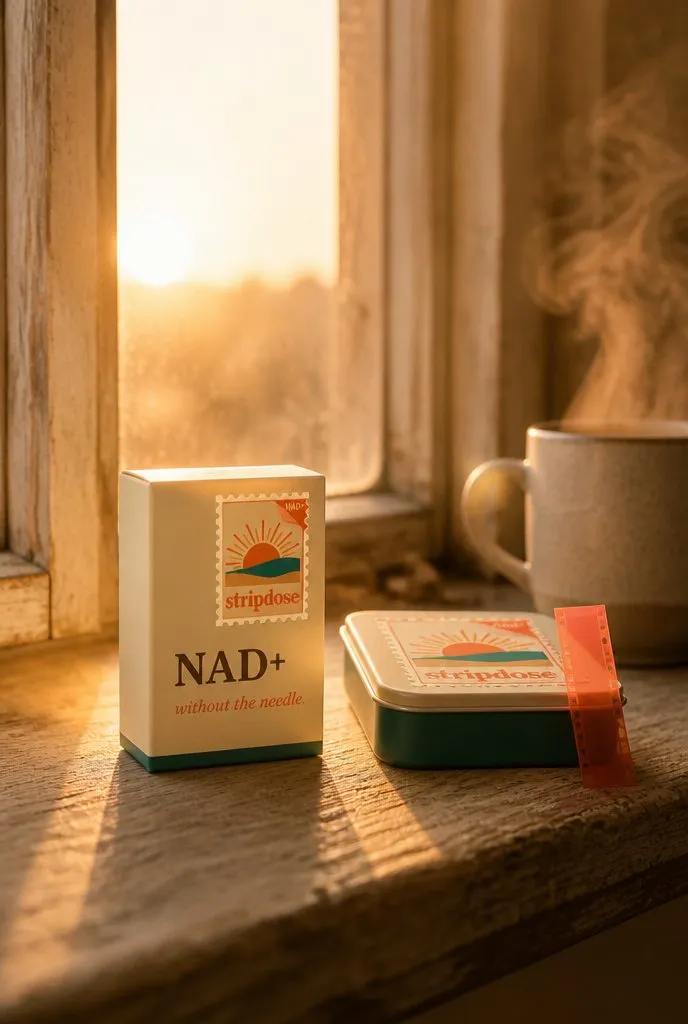
A dissolving strip makes a different bet entirely. There is no clinic visit, no vial to reconstitute, no spray bottle to prime. How the strip format actually works is refreshingly simple: a thin film, about the size of a postage stamp, that dissolves on the tongue in about sixty seconds — no water, no needle, no appointment. It travels in a pocket the way a stick of gum does, which matters more than it sounds like it should, because the routes people actually stick with tend to be the ones that ask the least of them.
In the strip, NAD+ is designed to support cellular energy production and the body's natural NAD+ levels, which decline steadily with age.* The strip does not change what NAD+ is or does. It changes how much friction stands between you and taking it consistently, which for most people matters more than any single delivery mechanic.
If you want to try the format before committing to anything, thirty strips run $109, with a ten-strip trial at $39 — a fraction of a single IV session, and nothing to reconstitute.
- Supports cellular energy production, the process NAD+ sits at the center of*
- Supports the body's natural NAD+ levels, which decline steadily with age*
- Promotes healthy aging and normal cellular repair processes*
What Research Does — and Does Not — Say About Oral NAD+
Human studies of NAD+ precursors show that blood levels of NAD+ can rise with supplementation — that part is fairly well documented. What researchers have not nailed down is how much of that rise comes from an oral or sublingual route specifically, strips included, compared with injection or IV. Oral and sublingual absorption research for NAD+ is real and ongoing, but it is earlier-stage than the IV literature, and anyone who tells you otherwise is skipping a step.
What research hasn't established yet
Whether an oral strip delivers meaningfully different amounts of NAD+ into circulation than swallowing it another way, or precisely how much reaches the bloodstream at all, is still being studied. We would rather say that plainly than round it up.
Cost, Hassle, and Comfort: The Honest Side-by-Side
Line the routes up and a pattern shows itself: the more clinical the route, the more it tends to cost and the more of your week it asks for. IV drips sit at one end — supervised, direct, and priced accordingly. Self-injection saves money but keeps the needle and adds a fridge shelf. Nasal sprays and patches remove the needle but bring their own inconsistency. The strip sits at the other end of that line: lowest hassle, lowest cost per use, and evidence that is still catching up to the format's popularity. That is the honest trade-off, not a hidden one. None of that makes the pricier, more clinical routes wrong for everyone — it just means the comparison deserves to be made honestly, with real trade-offs named instead of glossed over.
- IV drips: supervised and direct, highest cost, most time
- Self-injection: less expensive than IV, but the needle and the storage stay
- Nasal sprays and patches: needle-free, though dosing and absorption are harder to pin down
- Oral strips: needle-free and lowest friction, with evidence on the oral route still developing
So, Which Route Is Right for You?
There is no wrong answer here, only trade-offs. If you want the most-studied route and do not mind the appointment and the cost, IV keeps its reputation as the reference point. If you want NAD+ in your routine without a clinic, a vial, or a spray you are never quite sure landed right, the strip is built to be the calm, sustainable option. See the full NAD+ lineup to compare formats and pricing side by side.
Plenty of people end up using more than one route over time — an occasional IV before a big event, a strip for the ordinary morning. There is nothing wrong with mixing routes, as long as the reasons behind each choice are clear to you, and not just borrowed from whichever ad you saw last.
These statements have not been evaluated by the Food and Drug Administration. This product is not intended to diagnose, treat, cure, or prevent any disease.
Where StripDose fits
NAD+ oral dissolving strips — 100mg per strip, 30 for $109, or try 10 for $39. Needle-free, about sixty seconds.
Straight answers
On this topic.
Is NAD+ in a strip the same as an NAD+ IV?
Do NAD+ nasal sprays or patches work better than a strip?
Is NAD+ without injection FDA-approved?
Keep reading
Recovery
BPC-157 Oral vs. Injection: An Honest Comparison
BPC-157 oral vs. injection, without the confident claims neither route has fully earned — the honest state of the research, and the gentle case for a needle-free strip.
The Format
Needle-Free Peptides: Why the Format Is the Real Innovation
The needle was never really about the molecule — it was the barrier. An honest look at the needle-free peptide format, what it trades away, and what it still has to prove.