
Recovery · 6 min read
BPC-157 Oral vs. Injection: An Honest Comparison
BPC-157 oral vs. injection, without the confident claims neither route has fully earned — the honest state of the research, and the gentle case for a needle-free strip.
StripDose Editorial · Updated August 21, 2026
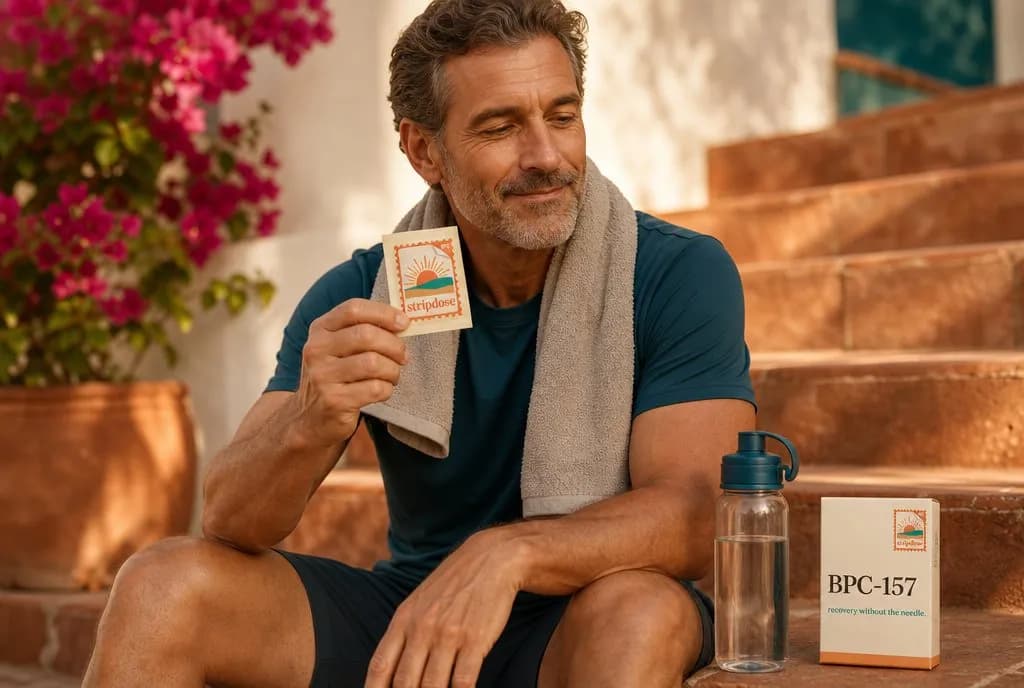
BPC-157: Oral Strip or Injection — Does It Matter?
BPC-157 has a loud reputation online and a quiet paper trail in humans. Both things are true at once, and the honest place to start is admitting it, before comparing how people take it.
If you haven't read the plain-English guide to what BPC-157 actually is, start there. It's a synthetic peptide — a short chain of amino acids — that researchers have studied since the 1990s. Most of what's published is preclinical: laboratory and animal work, not large human trials. That single fact shapes everything else in this piece, so we're saying it early rather than burying it.
BPC-157 tends to attract a particular crowd: lifters and runners nursing everyday wear, grapplers who collect small aches like trophies, desk-stiff bodies that never quite loosen up, and anyone whose gut has opinions about stress. Most of them found the name on a podcast or a forum thread, and most of them were never going to buy a vial and learn to draw a syringe. That's who this piece is actually for.
Why Injection Became the Default
For years, injection was simply the only serious way to try BPC-157. Peptides are chains of amino acids, and digestion exists to take those chains apart — the plain, unglamorous reason so many peptides end up in a syringe instead of a capsule. Injecting bypasses digestion and places the peptide directly into tissue.
In practice, that meant reconstituting a vial, drawing an exact volume, and giving yourself a shot, usually more than once. It works for people willing to do it, but it asks a lot of an ordinary week, and it asks even more of anyone who simply doesn't want a needle in the house.
There's also a quieter reason injection stuck around: it looked serious. A vial and a syringe carry an air of legitimacy that a bottle of capsules doesn't, even when the underlying human evidence is thin either way. That perception did real work in keeping injection the default, long after it stopped being the only option on the table.
What an Oral Strip Trades Away — and What It Trades For
An oral dissolving strip makes a different bet. Instead of injecting past digestion, it tries to get some absorption started in the mouth itself — under the tongue or along the cheek, where tissue is thin and blood vessels sit close to the surface — before the rest is swallowed the ordinary way. The science behind that route is real, but it's not the same as saying an oral strip performs identically to a needle. Nobody in this category can honestly say that yet, and we won't pretend otherwise.
What the strip trades for is everything injection asks of you. No vial to reconstitute. No syringe to draw. No wondering whether you measured correctly before the day has properly started. One film, dissolved, quietly — without the equipment.
The physiology behind that bet is real, even where the proof for BPC-157 specifically is still catching up. The lining of the mouth is thin and sits close to a dense network of small blood vessels, which is why researchers are interested in that route for peptides in general, not just this one. What's still being mapped is how much of a peptide BPC-157's size actually takes that path, versus getting swallowed and broken down the ordinary way.
What Research Explores for BPC-157
Kept to what published work actually supports, and kept soft on purpose: here is the structure and function territory BPC-157 research explores. In the strip, it's designed to support the following, gently and without promises.
- Supports the body's own, unhurried recovery processes*
- Promotes gut comfort and supports a healthy gut lining*
- Supports joint and soft-tissue comfort after training and everyday wear*
- Encourages normal tissue-repair processes — the quiet work your body already knows how to do*
What Research Hasn't Established Yet
Controlled human trials for BPC-157 are limited. That's not a technicality — it may be the single most important sentence in this article. Much of what circulates online extrapolates from lab and animal studies, sometimes generously. We'd rather undersell BPC-157 than oversell it, so we stop exactly where the human evidence stops.
This isn't a reason to write BPC-157 off. Early, preclinical signals are how most peptides start their research life. It's a reason to hold the language carefully until the human trials catch up — which is exactly what we're doing here, on purpose, even when it makes for a less exciting page than the forums.
What research hasn't established yet
Human data on oral or sublingual BPC-157 specifically, as opposed to injected BPC-157 in animal studies, is thinner still. How closely an oral dose behaves like an injected one is genuinely unknown, and we won't dress that gap up as settled science.
The Practical Case for a Needle-Free Strip
Set the evidence question aside for a moment, and there's still a practical argument for the strip: no vials in the fridge door, no sharps container, no second-guessing whether you drew the right amount. For a lot of people, that alone is the difference between trying BPC-157 and never getting past the syringe.
This is where the strip earns its place for a lot of people — not by settling the science, but by removing every excuse that had nothing to do with the science in the first place. No needle to work up to. No sharps disposal to figure out. No fridge shelf reserved for a vial. Just a film that dissolves quietly, the same way a breath strip does.
The BPC-157 strips run twenty films for $169, with every ingredient printed on the page — nothing to reconstitute, nothing to store cold. If you want the fuller picture first, the full BPC-157 overview walks through the format, the price, and the same honest limits covered here.
So, Oral or Injection?
There's no version of this answer that isn't honest trade-offs. Injection has more history behind the injected form specifically, and it asks more of you logistically. The oral strip removes the needle and the guesswork, and asks you to be comfortable with a research picture that's still filling in. Either way, go in with real expectations, not borrowed confidence from a forum post. Whatever you choose, the honest research picture is the same either way — early, real, and not yet finished.
If gentle, hedged language ever starts to feel unusual for this molecule, that's worth noticing too. It usually just means someone slowed down long enough to check what the evidence actually says before writing the sentence — which is the whole approach behind this page.
These statements have not been evaluated by the Food and Drug Administration. This product is not intended to diagnose, treat, cure, or prevent any disease.
Where StripDose fits
BPC-157 oral dissolving strips — 500mcg per film, 20 for $169. Gentle, needle-free, price on the page.
Straight answers
On this topic.
Is oral BPC-157 as effective as injected BPC-157?
Why does BPC-157 get gentler language than your other products?
Is BPC-157 FDA-approved?
Keep reading
Longevity
NAD+ Without Injection: Every Route, Compared Honestly
IV drips, injections, nasal sprays, patches, and dissolving strips — an honest, unhurried comparison of every way people try to get NAD+ into their morning.
The Format
Needle-Free Peptides: Why the Format Is the Real Innovation
The needle was never really about the molecule — it was the barrier. An honest look at the needle-free peptide format, what it trades away, and what it still has to prove.