
The Format · 7 min read
Needle-Free Peptides: Why the Format Is the Real Innovation
The needle was never really about the molecule — it was the barrier. An honest look at the needle-free peptide format, what it trades away, and what it still has to prove.
StripDose Editorial · Updated August 21, 2026
Why Are Peptides Almost Always Injected?
Ask why peptides are injected and most people assume it's about potency — that a shot simply works better. The real answer is duller and more honest: digestion. A peptide is a short chain of amino acids, the same building blocks as protein, and digestion exists specifically to take those chains apart. Injecting a peptide skips that gauntlet entirely. It's not that injection is magic. It's that it's the reliable way around one specific biological obstacle.
That single fact built an entire industry around needles — vials, syringes, sharps containers, refrigeration, and a learning curve most people never wanted in the first place.
None of this is a knock on injectable peptides. Plenty of well-studied compounds are injectable because the underlying science genuinely calls for it. The point is narrower: digestion, not effectiveness, is the reason the needle became the default packaging — and packaging is a more solvable problem than chemistry is.
The Needle Was Always the Real Barrier
Here's the part most peptide marketing skips: the needle itself, not the molecule, is what keeps most curious people from ever starting. A dislike of self-injection is common and rarely said out loud. Add the cost of clinic visits, the friction of paperwork, and the discipline an at-home injection schedule demands, and the real barrier comes into focus. It was never really about whether the peptide worked. It was about whether an ordinary person could keep the ritual up.
Wellness only works if you actually do it. A well-studied peptide with a needle nobody wants to use loses, in practice, to a lesser-studied option people will actually stick with. That's not a cynical take. It's just how habits work.
Talk to enough people who quietly stopped a peptide routine, and the same story repeats: not that it stopped working, but that keeping up with vials and a schedule got old. Adherence is unglamorous, but it's the actual variable that decides whether any wellness routine does anything for you at all.
The Bet Behind a Dissolving Strip
An oral dissolving strip is a considered bet, not a trick. The lining of the mouth — under the tongue, along the cheek — is thin and rich with small blood vessels, which is why some compounds can begin absorbing there before anything reaches the stomach. That's the whole premise: get ahead of digestion by a different route than a needle. The absorption science, told straight, says this route is real and studied, but exactly how much of any given peptide takes it, versus getting swallowed and broken down the usual way, depends on the molecule — and for many peptides, that split hasn't been precisely mapped yet.
We call it a bet on purpose. It's an educated one, built on real physiology, but it's not the same claim as performing identically to an injection. Nobody honest says that yet, for any oral peptide format, from any company.
It's worth being specific about what "considered" means here. Formulators choose film-forming ingredients and a dissolve profile meant to give a compound time in contact with tissue that might absorb it, rather than being swallowed instantly. That's engineering toward a hypothesis, built on real anatomy — not proof that any particular peptide takes advantage of it.
What a Needle-Free Format Is Designed to Support
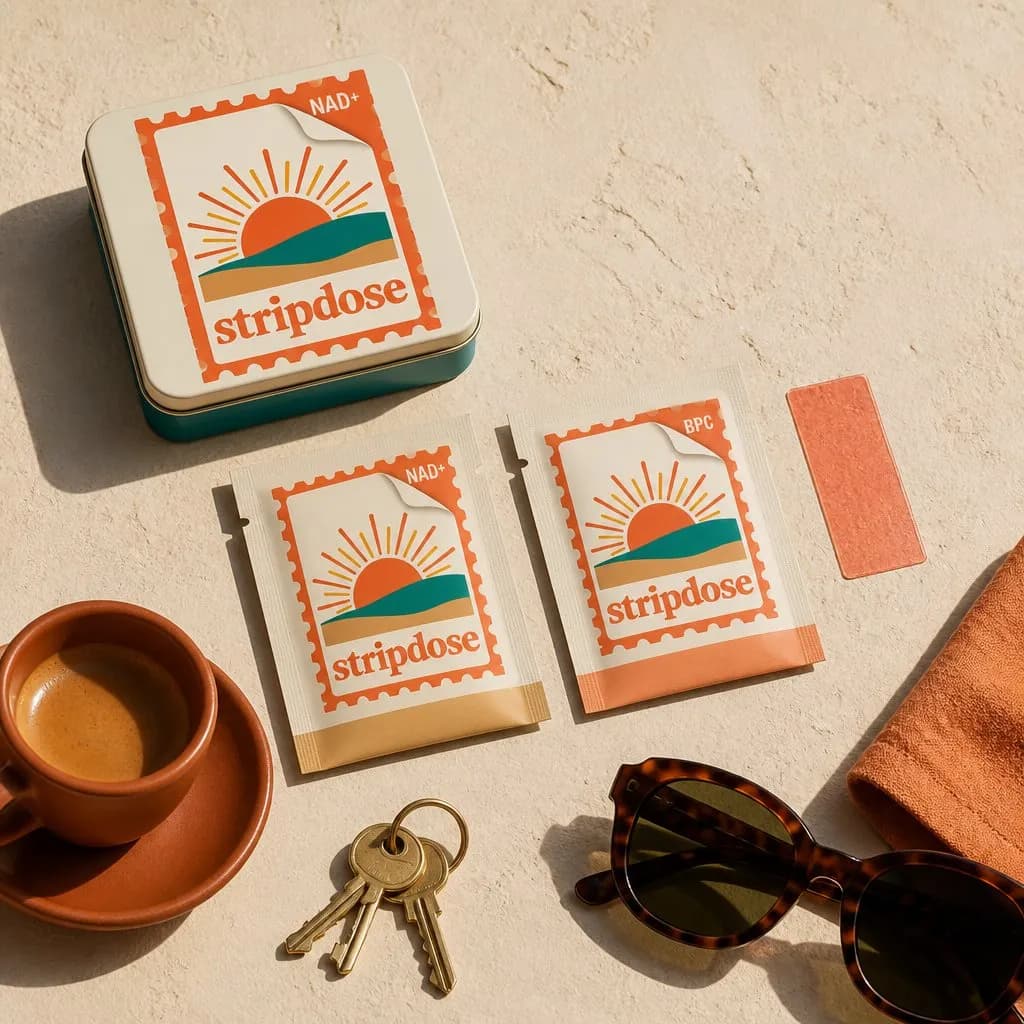
Every strip in this category makes the same kind of promise, adjusted for its molecule. NAD+ strips are designed to support cellular energy production and healthy aging.* Recovery strips like BPC-157 are designed to support the body's own recovery processes and joint and soft-tissue comfort.* Strips built around antioxidants are designed to support the body's antioxidant defenses and natural detoxification processes.* The claims are always structure and function, always hedged, and never a promise about how you'll feel or how fast. Every one of those claims is about an ingredient's ordinary role in the body, not about a specific outcome we can promise you.
- Third-party lab tested, every batch
- Dissolves on the tongue in about sixty seconds, no water needed
- Ships in 1-2 business days, with free shipping over $150
What the Research Still Owes Us
Here's the section a lot of wellness brands skip. Oral and buccal delivery of peptides is a genuinely promising route, backed by real physiology, but it's not a settled science. Precisely how much of any given peptide survives the trip through the mouth, versus getting broken down after swallowing, depends on the molecule's size, shape, and stability — and for most peptides in this category, that number simply hasn't been published yet.
That gap isn't a reason to distrust the format wholesale. It's a reason to read ingredient-specific claims carefully, here and anywhere else, and to notice when a company skips this section entirely.
What research hasn't established yet
We won't quote you a percentage for how much of any peptide is absorbed through the mouth versus swallowed, because nobody has published one we'd trust. The honest answer, molecule by molecule, is "still being studied" — and we'd rather say that than round up.
Three Honest Tiers, One Format
Not every strip in the full range is priced the same way, and we think that honesty matters as much as the format does. NAD+ and BPC-157 are retail: a price on the page, cart to checkout, nothing hidden. A second group is wellness-tier, offered by request rather than by cart, because those molecules deserve a real conversation before an order. A third group is prescription-class — GLP-1 compounds like semaglutide, the active compound in well-known injectable medications, among others — and those are available only after a licensed-provider consult, never straight to cart. Compounded prescription products are not FDA-approved, and we say so plainly, every time, not just in a footnote.
We built it this way on purpose. One "add to cart" button for every molecule would be simpler to code and easier to sell, but it would flatten real differences in how much evidence stands behind each one — and this whole brand is a bet that being honest about those differences is worth more than a simpler checkout.
The Needle-Free Bet, Summed Up
None of this makes the needle wrong. Injection has history, and for some molecules and some people, it may remain the more direct route. What we're building is the option for everyone the needle was quietly filtering out — the needle-averse, the too-busy-for-a-clinic, the just-wants-it-simpler crowd. A strip won't out-argue a syringe on paper. It might just be the one you actually keep using, which, in the end, is the only kind of wellness that works at all.
If the format eventually proves itself molecule by molecule, in real published trials, this whole conversation gets easier. Until then, we'd rather sell you a considered bet, clearly labeled, than a certainty we don't actually have.
These statements have not been evaluated by the Food and Drug Administration. This product is not intended to diagnose, treat, cure, or prevent any disease.
Where StripDose fits
Twelve strips across three honest states — a number, request pricing, or after your consult. Never a login wall.
Straight answers
On this topic.
Do needle-free peptide strips work as well as injections?
What does "needle-free" actually mean for a peptide?
Are all StripDose peptides available without a consult?
Keep reading
Longevity
NAD+ Without Injection: Every Route, Compared Honestly
IV drips, injections, nasal sprays, patches, and dissolving strips — an honest, unhurried comparison of every way people try to get NAD+ into their morning.
Recovery
BPC-157 Oral vs. Injection: An Honest Comparison
BPC-157 oral vs. injection, without the confident claims neither route has fully earned — the honest state of the research, and the gentle case for a needle-free strip.